A rchive Date
[ 05-06-2000 ]
Category
[ International Relations ]
sub-Categoy
[ U.S ]
|
[NASA picks up the slack
ISS won't suffer if Russia falls behind
Friday, February 4, 2000
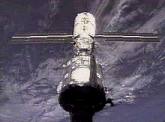 International Space Station
-- AP PHOTO, NASA
International Space Station
-- AP PHOTO, NASA
WASHINGTON (AP) -- The head of the space agency hopes the Russians will launch a service module to the International Space Station this year, but if they fail, he says, the United States will put up its own.
The Russian part of the space station initially fell behind schedule because the government didn't provide the money to meet the commitment. The effort was further delayed recently by two failures of Proton rockets, the launcher the Russians will use to put the modules in orbit.
The Russians have also diverted some equipment that was supposed to go to the space station to their aged Mir space station.
In an interview Thursday with reporters, NASA Administrator Daniel Goldin said he hopes the Russians, who are more than a year behind schedule, will complete and launch a service module by July.
Goldin said he's waiting to see if the Russians are serious about fixing the Proton and then launching the module before the United States puts the final touches on an American service module. He said the Russians will have a launch readiness review later this month.
"We want to see if they have a fire in the belly about getting the service module up," said the space agency administrator.
Goldin said that if Russia has not launched the service module by July, then NASA will do the final work on its own service module and launch it by the end of the year.
"We want the Russians to be there, but we felt we had to be responsible custodians to keep the program on track," he said.
Konstantin Kreidenko, a Russian Space Agency spokesman, said he had not seen the NASA statement and would not comment on it. He said the service module is ready but its launch was postponed because of the Proton crashes. Launched is planned for the end of July or early August.
The U.S. service module will cost about $200 million when it is finished and in place on the space station.
Goldin said that even if the Russians do launch their service module, the U.S. module will still be useful. He said it would be sent to the space station next year. Using both service modules "makes the station much more robust."
The multibillion-dollar International Space Station is a joint effort by 16 nations, with the United States taking the lead role.
 World Fact Book (CIA)] World Fact Book (CIA)]
|