A rchive Date
[ 06-10-2000 ]
Category
[ International Relations ]
sub-Categoy
[ Yugoslavia ]
|
[http://canoe.ca/Canoe/canoecnews.html
Yugoslav parliament seized
Friday, Oct. 06, 2000
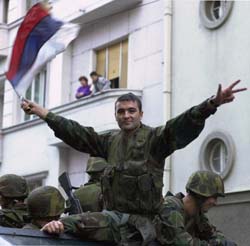
A member of the Yugoslav secret service "Unit for Special Operations" riding on a military vehicle waves a Serbian flag and gives the Serbian salute to opposition demonstrators Thursday in Belgrade. - AP |
BELGRADE, Yugoslavia (CP) - Jubilant Yugoslavs danced and sang in the capital's streets through the night and into Friday morning, celebrating the apparent collapse of Slobodan Milosevic's government and heeding calls to remain vigilant for counterattacks by Milosevic loyalists.
The euphoria of the tens of thousands of protesters was fed by their stunning seizure earlier of Yugoslavia's parliament, the state broadcasting centre and police stations, in an apparent death blow to Milosevic's 13-year rule.
Opposition leaders, wary of the sudden success, called on Yugoslavs to remain in the streets and be watchful of a possible backlash from their old adversary. But with many police putting down their clubs and standing aside as flag-waving crowds seized or destroyed the main symbols of the Milosevic regime, this appeared increasingly unlikely.
Top army commanders met in Belgrade Friday to decide how to react to the dizzying series of events that have brought opposition leader Vojislav Kostunica to the brink of power, but issued no statement after several hours of talks ended, reported Tanjug - the government's news agency until it defected to the opposition.
The army, whose top brass strongly supported Milosevic, will apparently stay out of the political fray, the agency said. No movements by military units were reported anywhere in the country.
Momcilo Perisic, a former army chief of staff and now an opposition figure, said he had contacted Yugoslavia's military leaders and that they had promised not to intervene.
Arriving in Belgrade Friday, Russian Foreign Minister Igor Ivanov made no comment as his car left the airport, but his main priority appeared to be assessing the situation and establishing ties with the new government in order to sustain Moscow's traditionally close relations with Yugoslavia.
Russian President Vladimir Putin has refrained from endorsing opposition claims of election victory, and world leaders anxiously awaited his reaction to events in Belgrade.
Another possible issue for talks could be the future of Milosevic, who may be looking for refuge abroad.
However, Russian Prime Minister Mikhail Kasyanov was quoted as saying on Friday that the question of asylum for Milosevic was not under consideration.
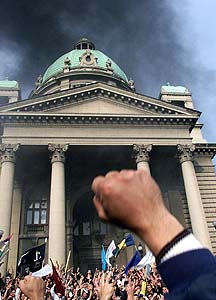
Smoke rises from the Yugoslav parliament building during clashes between riot police and opposition supporters in Belgrade, October 5, 2000. - REUTERS |
Meanwhile, the whereabouts of Milosevic and his family were unknown, although opposition campaign manager Zoran Djindjic said he was believed to have fled to a hide-out outside of Bor, some 80 kilometres southeast of the capital, near the borders with Romania and Bulgaria.
Milosevic's brother, Borislav, Yugoslavia's ambassador to Russia, told Reuters that the president was still in Belgrade and would meet with Ivanov later Friday.
In addition to Tanjug, all state-owned media were working normally Friday, broadcasting or publishing apologies for their past support for Milosevic.
State-owned or past pro-Milosevic dailies issued special editions Friday, reflecting the change in their editorial policies.
Governments of the two Balkan neighbours ordered their armed forces to remain alert to any attempt by Milosevic or his allies to slip out of Yugoslavia.
Djindjic later said he felt the critical overnight period when those in the military loyal to Milosevic could have struck back against the opposition supporters "was over."
But others warned that it was premature to write him off.
"He's not past history. As far as I know, it's not clear where he is. And while it seems clear that Kostunica and his people are in control of the key elements in Belgrade, the situation is very, very confused. I think we're seeing the end of an era but we're not quite there yet," U.S. ambassador to the UN Richard Holbrooke said at the United Nations.
However, Western governments were heartened by the prospect of an end to Milosevic's iron-fisted rule.
Prime Minister Jean Chretien said in a statement released Thursday: "The thoughts and prayers of the people of Canada are with the hundreds of thousands of Yugoslavs who have courageously demanded their democratic rights today in the streets of Belgrade.
"We call on Slobodan Milosevic to acknowledge their cry for freedom and step down; to accept what independent observers say was the clear result of the Sept. 24 vote - the election of Vojislav Kostunica."
At the White House, President Bill Clinton backed the protesters, saying: "The people are trying to get their country back."
Carl Schwenger, a spokesman for the Foreign Affairs Department in Ottawa, said 464 Canadians are registered as being in Yugoslavia.
There was no indication any were in need of immediate assistance. However, Canadian Embassy officials were keeping a close watch on the situation, which Angela Bogdan, the charge d'affaires, said was "unfolding minute by minute."
Kostunica appealed to people in the countryside to stream into Belgrade for more rallies Friday to secure the victory he claims he won during disputed presidential elections Sept. 24.
"The most critical moments are not over," said Vuk Obradovic, a former general turned opposition leader. "It is very important that people stay in the streets."
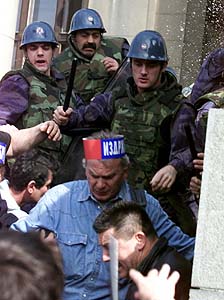 Riot police force opposition demonstrators from the steps of Yugoslav federal Parliament, Thursday October 5, 2000 in Belgrade. - AP Riot police force opposition demonstrators from the steps of Yugoslav federal Parliament, Thursday October 5, 2000 in Belgrade. - AP |
Momcilo Perisic, a former army chief of staff and now an opposition figure, warned that Milosevic and his closest associates were "determined" and may be planning a counterattack from somewhere outside Belgrade.
Perisic said he had contacted Yugoslavia's military leaders, however, and that they had promised not to intervene.
The regime's topple began Wednesday when police caved in to defiant coal miners striking in central Serbia, Yugoslavia's main republic.
After that, the movement gained stunning momentum. Opposition leaders had called on supporters from across the country to converge Thursday on Belgrade for a final push to force Milosevic to concede defeat by Kostunica in the Sept. 24 elections.
The crowd included tough miners, factory workers and farmers from opposition strongholds south of Belgrade. When they arrived, they stormed the doors of parliament, smashing through a cordon of riot police before taking control of the building. They set fires, tossed portraits of Milosevic out of broken windows and chased the feared riot police away.
Soon the state television building was also on fire, its front door crushed by a front-loader that farmers from Cacak had driven more than 95 kilometres to the capital. Then came word that at least two police stations had also succumbed to the crowds.
Faced with the mob's fury, many police tossed away their clubs and shields, absorbed by joyous flag-waving crowds surging across central Belgrade through clouds of tear gas. Others were beaten senseless by angry, often intoxicated young toughs.
The crowds showed little mercy to some of the symbols of the Milosevic regime. The director of Serbian state television and one of Milosevic's closest allies, Dragoljub Milanovic, was punched, kicked and pummelled with sticks as he tried to flee his television station.
Two people were killed and 65 injured in the rioting, and all but 12 of the injured were treated and released from hospitals, Tanjug reported.
 World Fact Book (CIA)] World Fact Book (CIA)]
|