A rchive Date
[ 10-09-2000 ]
Category
[ International Relations ]
sub-Categoy
[ Britain ]
|
[Big Brother watches Brits on candid cameras
Surveillance videos keep watchful eye on English
By JILL LAWLESS-- The Associated Press
Sunday, September 10, 2000
LONDON (AP) - One of Britain's favourite summer TV shows has been Big Brother, featuring people living under the constant gaze of surveillance cameras.
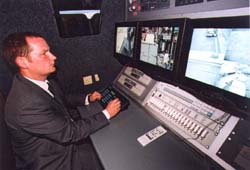
Westminster Council's mobile CCTV manager Paul Benge sits at the controls of the of Westminster Councils new CCTV "Supervan" in central London Wednesday Sept. 6, 2000. (AP Photo, Westminster City Council)
That's not so far from reality in modern-day Britain, whose 60 million people are tracked by an estimated 1.5 million closed-circuit TV cam.
Going to the bank or the supermarket, walking down the street, using a payphone, waiting for a train, slipping out for a pint at the pub, you're likely to be on camera.
"It's a mania," says Simon Davies of the civil liberties group Privacy International, which came up with the figure of 1.5 million. "The cameras are out of control."
The latest innovation is a roving surveillance "supervan" unveiled this week by Westminster City Council, which oversees London's entertainment - and crime - hot spots of Soho and the West End. The $273,000 Cdn vehicle sports a retractable mast and nine CCTV cameras, and this month will start prowling the streets looking for trouble.
"If we have reports of an outbreak of anti-social behaviour, we can deploy the van," said Westminster Council spokeswoman Suzanna White. "We may also want to use it in a covert manner - for example to collect evidence for legal proceedings."
The British government has poured millions into helping police forces and local authorities get the video technology.
Proponents of the cameras say they deter criminals and aid investigations. Their images, police say, were crucial in catching David Copeland, the bomber who targeted black, Asian and gay Londoners last year.
Surveillance is getting smarter and its reach greater. The throngs of shoppers on Oxford Street in London are tracked by 16 cameras linked to nearby Marylebone police station
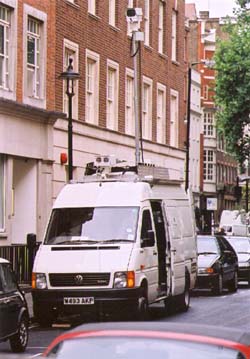 Westminster Council's mobile CCTV "Supervan" sits parked on a street in central London. (AP Photo, Westminster City Council)
Sally Humphreys, director of the Oxford Street Association, says the system has helped curb street crime and theft. According to Insp. Allan Thompson of Marylebone police, the system's record is mixed. In its first six months after being introduced in 1998, pickpocketing fell by 44 per cent, street crime by 20 per cent and burglary by 11 per cent. But pickpocketing is back to its pre-1998 level, while street crime stands slightly above the 1997 figure.
Thompson attributes the change to criminals being unaware of the cameras and to having fewer police on the beat.
Davies traces Britain's embrace of CCTV to the 1980s, when cameras were installed at soccer stadiums to combat hooliganism. From there, they spread to surrounding areas and city centres. Davies argues that cameras don't reduce crime, but merely displace it, and do little to deter professional or drug-fuelled criminals.
Opponents of the technology also argue the cameras are anything but neutral, all-seeing eyes. A study published in 1997 by researchers at Hull University's Center for Criminology and Criminal Justice found that camera operators often selected their targets based on racial prejudice and voyeurism.
"The only issues that have been raised have been raised by the media," counters Westminster Council's Humphreys. "Most members of the public realize that if you've not done anything wrong, you have nothing to worry about." Nonetheless, the 1998 Data Protection Act says people must be told they are being filmed - although in practice the law is not always enforced.
Police officer Thompson said big warning signs were set up in Oxford Street, but the municipality ordered them removed.
Local governments in the United States have been slower to adopt camera surveillance, says Robert Ellis Smith of the Rhode Island-based newsletter Privacy Journal. He estimates that fewer than 50 U.S. municipalities have set up video surveillance in downtown areas.
But cameras are pervasive on U.S. and Canadian highways and urban intersections, in shopping malls, banks and workplaces. "I don't think anybody in the U.S. has stopped to consider the impact on our culture," said Smith.
Even police inspector Thompson urges caution, saying cameras should be kept out of residential areas. "I wouldn't be too happy if someone put a CCTV camera in my street," he said.
 World Fact Book (CIA) World Fact Book (CIA)
|