A rchive Date
[ 07-03-2005 ]
Category
[ Science ]
sub-Categoy
[ Anthropology ]
|
[Human-Neanderthal link challenged
DNA evidence suggests different evolutionary paths
By JEFF DONN -- The Associated Press
Wednesday, March 29, 2000
DNA extracted from a 29,000-year-old bone has cast doubt on the theory that modern humans evolved in part from squat, heavy-browed Neanderthals, researchers say.
Researchers compared DNA from a Neanderthal skeleton found in Russia to an older sample tested in 1997. While the two Neanderthal samples turned out to be just 3.5 per cent different from one another, they were roughly seven per cent different from DNA in modern humans. Scientists consider that to be a substantial gap.
"It all points away from the Neanderthal," said one of the researchers, William Goodwin, a molecular biologist at the Human Identification Centre in Glasgow, Scotland.
The findings are being published in Thursday's issue of the journal Nature.
The researchers challenge the theory that modern humans evolved at least partly from Neanderthals, which some believe mated in large numbers with modern Europeans before disappearing 25,000 years ago.
If that had happened, some argue, today's Europeans would show stronger genetic similarities to Neanderthals than other humans do. Yet the latest DNA analysis shows Neanderthal DNA to be no closer to Europeans than to other modern humans.
Neanderthals were burly, primitive creatures with a prominent brow, thick jaw and short, powerful limbs. Originating in Africa, they appeared in Europe and Asia perhaps 100,000 years ago or longer.
The 29,000-year-old Neanderthal DNA, which was recovered from a rib bone in a baby's skeleton found in Russia's Caucasus Mountains, was in better condition than the roughly 40,000-year-old Neanderthal DNA from Germany analysed in 1997, the researchers said.
The research team from Scotland, Sweden, Russia and the United States reassembled more than two per cent of the later Neanderthal DNA from a tiny cellular structure known as the mitochondria.
Molecular biologist Matthias Hoss, an expert in ancient remains now working at the Swiss Institute for Cancer Research, said the research appears to support the theory that Neanderthals were an evolutionary dead end.
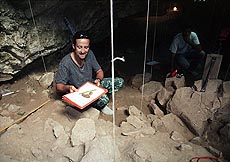 Scientist Alban Defleur of the Universite du Mediterrane at Marseilles holds a Neanderthal thigh bone in a cave on the Rhone River in southern France. (AP Photo/UCAL Berkeley, Tim White) Scientist Alban Defleur of the Universite du Mediterrane at Marseilles holds a Neanderthal thigh bone in a cave on the Rhone River in southern France. (AP Photo/UCAL Berkeley, Tim White) |
"This adds quite a lot of confidence that the Neanderthal didn't contribute to modern populations," he said.
The study does support an opposing theory known as "out-of-Africa," the research team said. This theory says modern humans descended from the true Homo sapiens, who originated in Africa and came to replace other early humans worldwide without great mixing. Homo sapiens would have arrived in Europe perhaps 30,000 to 40,000 years ago, scientists believe.
However, some experts question the researchers' broader conclusions, saying mitochondrial DNA may evolve faster than the researchers assume.
"Maybe 40,000 years ago, everybody's mitochondrial DNA is very different from humans of today," said Fred Smith, an anthropologist at Northern Illinois University.
Milford Wolpoff, a University of Michigan anthropologist who studies early human fossils, said fossils suggest an evolutionary link between Neanderthals and modern humans. He said late Neanderthal fossils seem to be evolving toward modern humans in some ways, as they develop chins and lose their low, sloping foreheads.]
|